
Tracks carry the door's weight: what the makers say
Steel-Line's sectional door manual limits an owner's maintenance to lubrication and inspection, with every other repair left to qualified door service personnel. B&D says never to touch or adjust parts while the door is moving, and for a door that has left its rails its words are 'Do NOT attempt to lift the door back onto the guiderails on your own'. Leave the bottom corners of a sectional door completely alone: Steel-Line warns never to loosen the bottom cable fixtures there.
What garage door rollers, tracks and hinges do
B&D describes a sectional door as panels that run on tracks, straight up and then across the ceiling. The rollers are what carry it along those tracks, and B&D puts a typical sectional door at 80kg to 150kg, or more for a double.
There are more of them than people expect. Steel-Line counts a dozen rollers on a standard five-section door. B&D's standard Panelift runs on a single 48mm wheel of heavy duty nylon coated steel on ball bearings, while its Panelift Icon runs on double-wheel tracks.
Rollers and tracks on each kind of door
| What it runs on | What else is close by | |
|---|---|---|
| Sectional door | Rollers in a track on each side, up and then back along the ceiling | A torsion spring above the door, and lift cables fixed at the bottom corners |
| Tilt door | Tracks at each side | Extension springs in pairs along each side of the tracks, which Steel-Line says need safety cables in case one breaks |
| Roller door | A side guide on each side for the curtain | Helical springs inside the drum above the opening |
Signs your rollers, tracks or hinges are wearing
- Rollers with cracks, chips or obvious wear, the three things Steel-Line says to look for
- Grinding or scraping, or a door that runs less smoothly than it used to: Merlin says stop using it and have it fixed
- A loud run on metal rollers in metal tracks
- A track that is dented, bent or out of line
- Bolts, hinges or brackets working loose
- Rust on the hinges or tracks, which Steel-Line says is common near the sea
- Leaves, debris or rust sitting in either track
How often should you replace garage door rollers?
Steel-Line has given two answers. Its 2021 maintenance guide says every 10 to 20 years depending on use, and a May 2025 article says rollers last 7 to 15 years depending on the material. Treat them as a range, not a due date, and go by what the rollers look like.
Use does the wearing. Steel-Line says the average family runs its garage door 3 to 5 times a day, nearly 2000 times a year, so a door that is how everyone comes and goes wears faster than one opened at weekends.
When they are worn, they all go: expect the whole set to be quoted, not just the noisy one.
Metal or nylon garage door rollers
Steel-Line says metal rollers running in metal tracks are loud, while nylon ones are much quieter, need no lubricant and need less maintenance. Its own replacement sectional roller is white nylon with a bearing and a 165mm stem, to suit a 50mm track, which is a reminder that a roller has to match the track it runs in.
Rollers are not the only noise. Gliderol lists loose hardware such as track brackets and U-shaped buckles, worn rollers or hinges, and spring problems as causes of unusual sounds. For a door that is loud rather than worn, the noisy garage door guide goes through the rest, and the lubricant guide covers what goes where.
Bent or damaged garage door tracks
A bent track is tempting to tap straight. Leave it. The track and its brackets are holding up the door, and Steel-Line says a dented or misaligned track can make a roller door jam. B&D's owner check stops at looking: both tracks clear of debris and rust, not bent or out of line, brackets and bolts tight.
A binding door also wears its opener. Merlin's MR855EVO manual says sticking, binding or unbalanced doors must be repaired before an opener goes on, because the opener must not be left to compensate for them. So a door that has started to catch in one spot is worth looking at early.
If the door has come out of its track, that is a different job. Stop using it, keep everyone clear and send it as stuck open or off its track so it is marked urgent. The stuck door guide covers what to do while you wait.
Garage door hinge replacement
Hinges loosen with ordinary wear, Steel-Line says, along with bolts, nuts and brackets, and they need tightening before they let the door come off its tracks. Near the sea, it names hinges among the parts rust most often attacks.
Steel-Line's manual says never to paint tracks, rollers or hinges, so a rusted hinge is replaced rather than painted over. A loose one is tightened at a service, and a cracked or rusted-through one is swapped for a hinge that suits the door.
What a roller and track repair involves
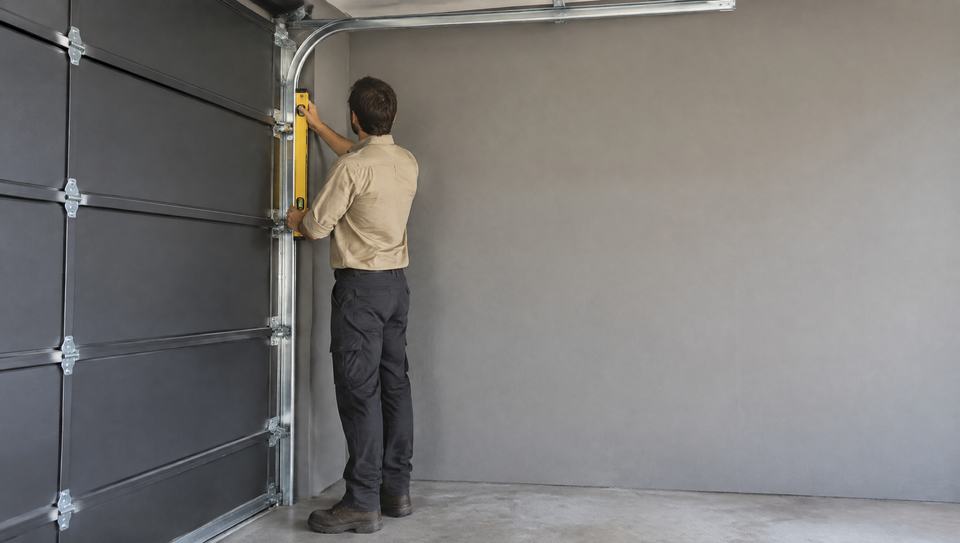
The door specialist starts with the door closed and the opener disengaged. They check the rollers for wear, the tracks for line and level, and the hinges, brackets and bolts for anything loose. Steel-Line's maintenance guide has the tracks checked with a level so they run even and straight, and track alignment and hardware tightness are both on B&D's list of what a service covers.
Worn rollers come out as a set and new ones go in to suit the track. Damaged track is lined up again or replaced, and loose fixings are tightened. Lubrication follows the door's own manual, never grease in a roller door's guides. Before they leave, the door is run under the opener and the reversing test is done in front of you.
What to tell the door specialist
- Sectional, tilt or roller door, and single or double
- What you hear: grinding, scraping, squealing or a thud
- Whether the door catches in one spot or runs crooked
- Whether it has ever come out of its track
- Roughly how old it is and how often it runs
- Whether you live near the sea
What you can do, and what to leave
You can
- Look along both tracks for leaves, debris and rust, as B&D suggests
- Listen to one full run from a safe distance
- Keep grease and oil out of the tracks
- Keep hands clear while the door moves
Leave to a door specialist
- Replacing rollers, the whole set at once
- Straightening, lining up or replacing a track
- Tightening track brackets and mounting bolts
- Changing hinges
- Anything at the bottom corners of a sectional door
- Putting a door back into its track

What we would do
If your sectional door still runs on metal rollers and the noise is what bothers you, ask whether nylon ones would suit its track. A full set goes in at once anyway, so the replacement visit is the natural time to make the change, and Steel-Line says the nylon kind needs no lubricant afterwards.