
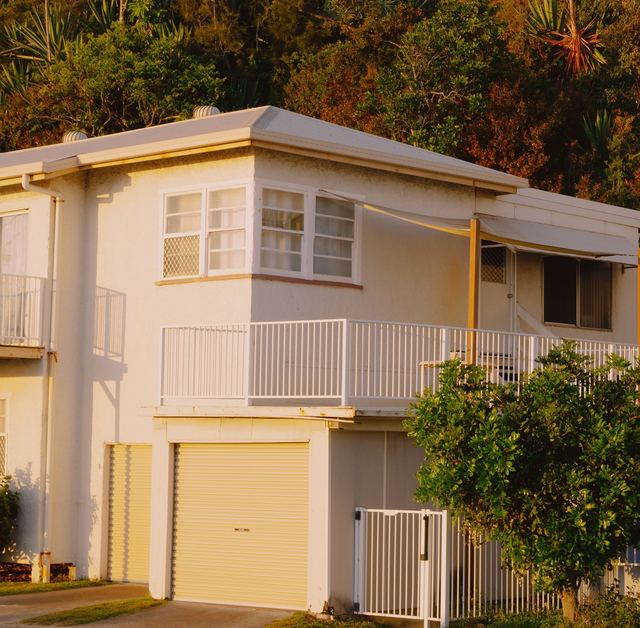
Why the garage door matters in a cyclone
After Cyclone Yasi in 2011, the Cyclone Testing Station surveyed the coast from Innisfail to Halifax and found that homes built to the standards brought in during the 1980s generally stood up well to the wind. Roller doors were one of the exceptions: 29% of roller doors in its street surveys were damaged, against 6% of sectional doors, while fewer than 3% of post-1980s homes had significant roof damage.
The usual failure was a roller door coming out of its side guides, then off its drum, and becoming wind-borne debris. Once a big door has gone, the report says the pressure inside the building can change sharply, and the Queensland Government says protecting the outer skin of a home from wind pressure significantly improves the chances of keeping the roof.
Garage door wind rating: what AS/NZS 4505 means
A wind rated garage door is built and tested to AS/NZS 4505, the Australian and New Zealand standard for garage doors and other large access doors. Standards New Zealand lists the 2012 edition as current; it was published on 6 February 2013, with Amendment 1 following in 2015.
The Queensland Government's garage door factsheet says many garage doors made before the current standards were not reinforced and could not withstand the wind pressures of a severe weather event, and that the AS/NZS 4505 test simulates significant wind loads.
Windlock roller doors and other wind rated doors
Wind locks anchor the edges of a roller door's curtain to its side guides, so the wind can't pull the curtain out. In the Yasi surveys, roller doors fitted with wind locks performed better than doors without them.
Makers do it in different ways. Steel-Line's wind rated roller door has a moulded lug on the curtain that locks into a matching side guide, and Steel-Line says it was tested at the James Cook University Cyclone Testing Station against AS/NZS 4505-2012. On its Wind-Rated Roll-A-Door, B&D fixes the curtain to the door frame with wind clips.
Wind rated sectional doors exist too: B&D sells a high-wind sectional door called Storm-Shield and a cyclone door called Windpanel, and Gliderol's Storm•Safe range covers cyclone-rated roller and sectional doors.
Where the building code asks for one
Under the NCC 2022 Housing Provisions (clause 2.2.4), a garage door in an opening no more than 3 m high in an external wall of a home in wind region C or D must meet AS/NZS 4505. Western Australia's version of the clause adds wind region B.
NCC 2025 adds wind region B2 to the same clause. It applies from 1 May 2026 in the ACT, Victoria and Western Australia (the ACT and WA with a 12 month transition) and from 1 May 2027 in New South Wales, Queensland, South Australia and Tasmania. The Northern Territory has not adopted it.
Steel-Line notes that new homes in cyclone-prone areas of northern Australia now have to use wind-resistant garage doors, installed to meet the current code. In Queensland, building work valued over $3,300 needs a QBCC licence.
Wind regions the government guides name
| Wind region (2011 map) | Built to resist | Who says so | |
|---|---|---|---|
| Cairns, Townsville, Mackay, Gladstone | C (cyclonic) | A Category 4 cyclone, gusts of about 250 km/h | Australian Journal of Emergency Management, October 2023 |
| Broome | C (cyclonic) | A Category 4 cyclone, gusts of around 250 km/h | WA Tropical Cyclone Preparedness Guide, August 2020 |
| Port Hedland, Karratha | D (cyclonic) | A Category 5 cyclone, gusts of around 300 km/h | WA Tropical Cyclone Preparedness Guide, August 2020 |
| Brisbane, Gold Coast, Sunshine Coast, Fraser Coast | B (intermediate) | Weakened tropical cyclones, design wind speeds up to 205 km/h | Australian Journal of Emergency Management, October 2023 |
| Geraldton | B | Weakened tropical cyclones | WA Tropical Cyclone Preparedness Guide, August 2020 |
Your own home's rating
The table only lists places those guides name. Wind classification is set for each site, not each town, so your plans or your council have the answer for your house. Steel-Line's brochure gives the same advice: check with the local council for the home's wind load requirements and design pressure.
The Queensland Reconstruction Authority says Region C homes designed to AS 4055 get a classification of C1, C2, C3 or C4 depending on the site, such as near open water, on a hill or among other buildings, and that garage doors must be rated to the wind classification shown on the plans.
The Queensland grant has closed
Queensland's Household Resilience Program, which helped owners of older homes near the coast of Central and North Queensland pay for upgrades such as wind rated garage doors, closed to new applications on 2 October 2026.
When we checked on 3 November 2026, its page mentioned no future round. We don't apply for grants for anyone, and a door job you tell us about has no link to any grant.
It is still worth asking your home insurer whether a wind rated door could help your premium. The Queensland Government's garage door factsheet suggested the same.
What to do before cyclone season
Find your wind classification
Look on the plans for the house, or ask your council.
Look at the door you have
Is it a roller or a sectional door, and are there wind locks or clips along the curtain edges? Note any rust at the guides, dents or loose fixings, but don't loosen or tighten anything yourself.
Get work done early
Steel-Line notes that cyclones can affect Australia's eastern, northern and western coastlines each year from November to April, so arrange any repair or replacement well before then.
Ask about bracing
The WA Tropical Cyclone Preparedness Guide recommends wind and debris rated doors, plus a temporary bracing system to fit before a cyclone. Ask the door specialist whether bracing suits your door.
Tell us the job
Choose a replacement and say the house is in a cyclone region, so the door specialist who takes the job knows to quote wind rated doors.
After a storm, leave a damaged door alone
A door that has been pushed in, pulled out of its guides or buckled is still under spring tension. B&D says not to try lifting a door back onto its guide rails on your own, because springs or cables may be broken, and Steel-Line's manual says never to loosen any fastener on the spring assembly. Keep clear and tell us the job.
Details that help with a quote
- Your home's wind classification, if it is on your plans
- Roller or sectional, single or double, and roughly how old the door is
- Whether the new door replaces an existing one or goes into a new opening
- Any storm damage, and whether the door still runs

What we would do
Ask whoever quotes for the AS/NZS 4505 test evidence for the exact door and size they are offering, and how its guides will be fixed to your frame. The Yasi report found some doors with wind locks still failed by tearing their guides away from the structure, so the fixings matter as much as the curtain.