
Garage door opener not working? Look at the door as well
An opener moves a door that should already be balanced. Steel-Line says spring forces are generally equal to the door's weight, so the springs carry the load and the motor mostly steers it. When a spring tires or fails, the opener tends to get the blame.
B&D lists an opener that hums or strains without lifting the door among the signs of a broken spring. Steel-Line says a roller door out of balance strains the motor as well. So a garage door motor repair starts with one question: is the motor really at fault?
What the opener is doing, and where that points
| Where it points | What to do first | |
|---|---|---|
| Nothing from the wall button or the remote | Power to the opener | Check the plug and that the power point is switched on |
| Wall button works, remote does not | The remote or its battery | Fit a new battery and try again |
| Hums or strains, door stays put | B&D lists this as a sign of a broken spring | Stop using the opener and send the job |
| Closes part way, then goes back up | Something in its path, a blocked beam or dirty tracks | Clear the opening and the beams, then wipe the tracks |
| Runs, but very loudly | Steel-Line says tracks and hinges may need cleaning | Wipe the tracks and book a service if the noise stays |
| Lifts crookedly | B&D lists this as a sign of a broken spring | Stop using the opener and send the job |
Why a garage door reverses or stops halfway
A door going back up can be doing what it was built to do. B&D says all its openers stop and reverse when the door touches something, and that its infrared beam pauses or reverses the door if the beam is blocked. Look for a bin, a bike wheel or a broom across the opening before you suspect the motor.
Steel-Line adds a cause that catches people out: dirty tracks and hinges, with brick dust from new building work a common source. If the fault began during renovations, clean the tracks first. B&D's Smart Pro manual suggests a cloth dampened with mineral turps or methylated spirits, and Steel-Line says to keep the tracks clear of oil and grease, because grease attracts dust.
If a spring may be broken, stop pressing the button
B&D's advice when a spring breaks is to stop using the opener immediately, because running the door could strain the motor, cables or tracks. Steel-Line's manual is just as firm: 'If a spring breaks, DO NOT ATTEMPT REPAIR'. It says the door is under extreme spring tension at all times. It leaves spring and cable work to a trained door technician, so never touch them to get a motor going again.
Getting the car out while the opener is down
Openers have a manual release so the door can still be run by hand. Steel-Line says its key release is there for when the opener fails or the power is out, and is especially useful when there is no other way into the garage.
Use it with care. Chamberlain's support page says to use the release only when the door is fully closed, if possible, and Merlin warns that a door with weak or broken springs may fall rapidly. Going by those warnings, if the door is up and you suspect a spring, leave the release alone and keep everyone clear. The manual release guide has the steps for a closed door.
Repair the garage door motor or replace it?
Look at the warranty first. Some makers tie the motor's cover to servicing: Gliderol says missing a service every 18-24 months voids the 5 year motor warranty on its Glidermatic Heavy Duty and Dual openers. Find the label on the motor and any service papers before the door specialist calls.
Then ask about the door. B&D's Smart Pro manual describes running the door by hand with the opener disengaged: it should move smoothly and take no more than 20kg of force at the bottom rail. A door that fails that check will strain any motor, new or old. If the door passes and an older opener keeps stopping, replacing the motor can make more sense than another repair.
Some repairs reach the wiring. A new power point near the ceiling, or new wiring to the opener, is electrical work in every state, and the law wants the correct electrical licence for it, so that part goes to a licensed electrician.
What a garage opener service should look at
- Reversing: Steel-Line's manual has a monthly test with a piece of wood laid flat in the door's path. If the door does not reverse, have the opener repaired.
- Balance: the hand check from B&D's manual, done by the door specialist.
- Safety beams: clear and lined up. B&D's manual puts the beam 100mm above the ground.
- Guide tracks: B&D's manual says to clean inside them every 3 to 6 months.
- Release cord: Merlin says to check it for fraying, and that everyone in the family should know where it is.
What you can try, and what to leave
You can
- Fit a new remote battery
- Press the wall button and note what the opener does
- Check the plug and the power point switch
- Move anything away from the beams and the door's path
- Wipe the guide tracks clean, with no oil or grease
Leave to a door specialist
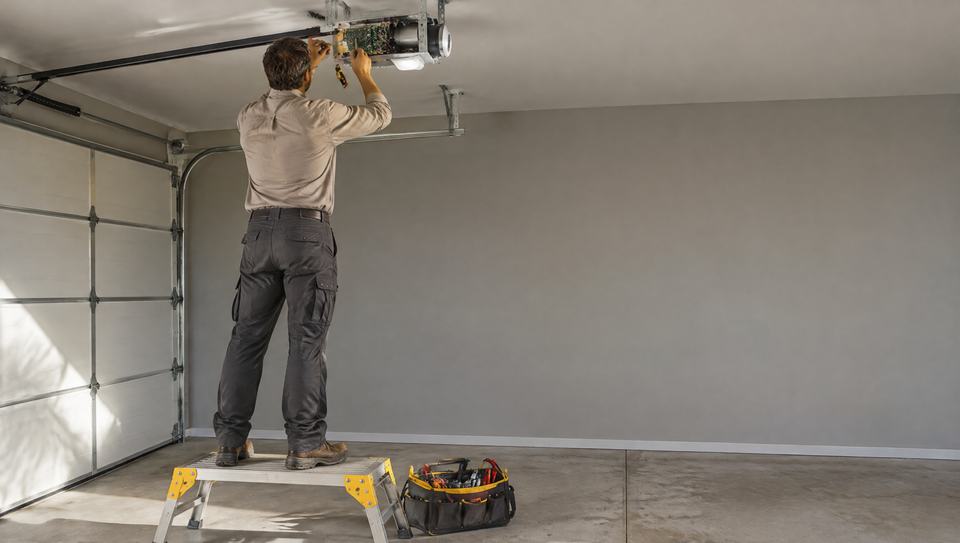
- Anything inside the motor cover
- Springs, cables and anything under tension
- A door that jams, lifts crookedly or is off its track
- A new power point or hard wiring, by a licensed electrician

What we would do
Press the wall button once, stand back and listen before you try anything else. Note whether you get silence, a click or a hum, and whether the door moves at all. Tell the door specialist exactly that when they call. A hum with a still door sends them to the spring before the motor, and silence sends them to the power.